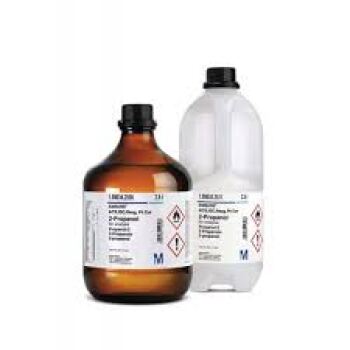
Sulphuric Acid 98% AR 2.5L
In a laboratory, sulfuric acid (H2SO4) has many uses, including:
Creating other acids
Sulfuric acid can be used to create other acids, such as hydrochloric acid and nitric acid.
Creating synthetic materials
Sulfuric acid can be used to create synthetic detergents, pigments, dyes, and sulfate salts.
Processing metals
Sulfuric acid is widely used in processing metals.
Acting as a catalyst
Sulfuric acid can act as a catalyst in reactions, such as the esterification reaction.
In laboratory settings, Sulphuric Acid AR is used in titrations and as a reagent for various chemical analyses.
Its high purity ensures accurate and reliable results, which is essential for scientific research.
Additionally, it is used in the preparation of samples, pH adjustment, and as a dehydrating agent.
Sulphuric acid is also known as oil of vitriol. It is a colorless, odorless, and viscous liquid that is soluble in water.
It is extremely corrosive and destructive to tissue, and can be carcinogenic to humans.
Sulfuric acid should be handled and stored carefully.
It is incompatible with many materials, including bases, halides, organic materials, carbides, and nitrates.
It reacts violently with cyclopentadiene, cyclopentanone oxime, nitroaryl amines, and powdered metals
sulphuric Acid 98% AR 2.5L
Potassium Dihydrogen Phosphate AR 500g
Hâ‚‚KOâ‚„P
Â
Â
Other Names
MONOPOTASSIUM PHOSPHATE
Potassium dihydroxidodioxidophosphate
Potassium phosphate monobasic;
Phosphoric acid, monopotassium salt;
potassium biphosphate
Â